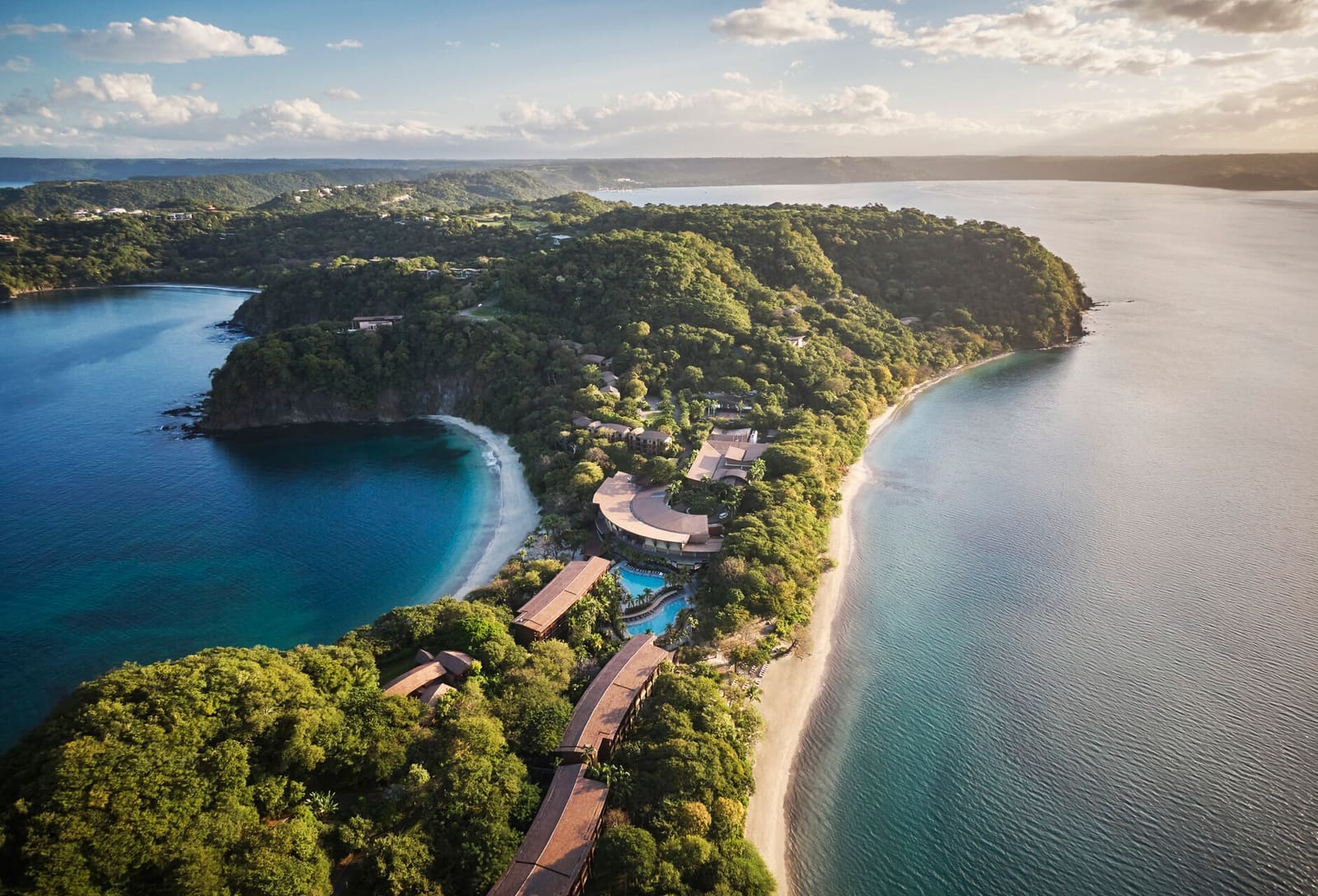
On July 17, 2026, one of the most significant transactions in the recent history of Costa Rican tourism closed almost without a sound: Peninsula Papagayo, the crown jewel of luxury development in Guanacaste, now has a single owner.
Mohari Hospitality bought out its U.S. partner Gencom's remaining 30% stake, taking full 100% control of the 2,200-acre peninsula — hotels, residences, concessions, and every ounce of future development potential.
Let me break down what this actually means — no fluff, in plain English: for the country's tourism, for Guanacaste, and very specifically, for you, if you're thinking about buying property on this coast. Because a headline that sounds like "distant billionaires doing billionaire things" is actually sending a direct signal about the value of homes and lots all along the North Pacific — including Playas del Coco, Playa Hermosa, and Ocotal, which sit literally next door.
First, the basics: what is Papagayo, and what just happened?
Peninsula Papagayo is a 2,200-acre enclave on Costa Rica's North Pacific coast, inside Guanacaste. It's not a hotel — it's a planned luxury city. Inside its gates live three of the most expensive hotel brands on the planet: the Four Seasons, the Andaz (Hyatt's luxury line), and Nekajui, a Ritz-Carlton Reserve (Ritz's rarest, most exclusive tier, with only a handful worldwide) — plus private residences, a park, a marina, and high-end residential neighborhoods like Bahías and Enclaves. It borders the UNESCO-recognized Área de Conservación Guanacaste, one of the most biodiverse regions in the Americas.
For ten years, two groups developed the project as partners: Mohari (majority owner) and Gencom (30%). What just happened is that Mohari bought Gencom's share and now owns the entire thing. The operational handover will happen gradually over the next 12 months, with a public promise to maintain continuity for residents, guests, and employees.
In short: this isn't a new owner arriving to improvise. The owner who already knew the house intimately, for a decade, decided to buy the whole thing. That distinction changes everything — as I'll explain below.
Who is the new sole owner? And why his backstory matters
Mohari Hospitality was founded in 2017 by an entrepreneur named Mark Scheinberg. The name probably means nothing to you — but his story has a twist that hits close to home for us Costa Ricans.
Scheinberg is the mind behind PokerStars, the largest online poker platform that ever existed, which he sold in 2014 for roughly $4.9 billion. Forbes today estimates his fortune at over $5 billion. With that money he built Mohari, a firm that collects super-luxury hospitality assets around the world: the Four Seasons Madrid, the historic Bauer Hotel in Venice, projects in Paris, Miami, and Lake Tahoe, the Ritz-Carlton Yacht Collection, and the Tao and Hakkasan restaurant groups.
Here's the detail almost no one is reporting, and the one I — as a Costa Rican — find to be the heart of this story: Scheinberg founded PokerStars in 2001 from Costa Rica. This is where it all started for him. The man now buying Guanacaste's crown jewel built his first empire on Costa Rican soil 25 years ago. He isn't a stranger betting blind — he's someone who bet on Costa Rica once, won big, and is now putting his chips back on the exact same square. Papagayo was, in fact, Mohari's very first investment, and its founder calls it one of his "defining" assets.
When a billionaire who could park his money anywhere on earth chooses to consolidate his ownership right here, that isn't sentimentality. It's a cold read on the long-term potential of this coast.
Signal #1 for tourism: Costa Rica is still a super-luxury bet
The first thing this deal tells us is about the health of the national tourism engine. A global investor does not buy out 100% of an asset that's on its way down. He does it when he sees that the best chapter is still ahead.
Mohari was explicit: it bought Gencom's stake after a period of strong operating performance, robust demand for the residences, and significant investment in the destination. Translated: the hotels are filling up, the homes are selling, and there's appetite to build more.
For Guanacaste tourism, this means three concrete things:
More investment, not less. The company has already signaled it will keep investing in hotel offerings, residential product, and guest experience. A single owner decides faster and more ambitiously than a partnership that has to reach consensus on every move. Fewer brakes, more building.
Protected jobs. Papagayo is one of the largest private employers in Guanacaste. Through its nonprofit Creciendo Juntos — now celebrating 25 years — it supports 19 neighboring communities in education, health, and economic opportunity. Mohari confirmed that social dimension continues. For local families, that's stability.
The brand-magnet effect. Every time a Four Seasons, a Ritz, or an Andaz reaffirms its bet on a region, it pulls in other brands and more high-net-worth travelers. Luxury attracts luxury, and the guest who lands at a Ritz spends across the entire region.
Signal #2 for real estate: the model reshaping Guanacaste
Here's where the story stops being "tourism" and becomes directly your topic if you want to buy.
Papagayo is the country's largest example of a model called branded residences — homes and condos that carry the name and standard of a hotel chain. Buying a "Four Seasons Private Residence" or an Andaz residence means owning a home with the hotel's service, security, maintenance, and prestige right next door.
That model is reshaping the entire North Pacific market — and not just inside Papagayo. When the region's anchor asset doubles down, the value standard of everything around it rises with it. Costa Rican financial press has been documenting exactly this: Guanacaste is cementing its real estate recovery precisely on the back of residential product tied to hotel brands.
Why does this matter to you, even if you're not buying a multimillion-dollar home inside Papagayo? For one simple reason of geography and market dynamics: prestige spills over.
The local's angle: you don't have to buy IN Papagayo to win WITH Papagayo
This is what a brochure won't tell you, and what I — born and raised on this coast — will tell you straight.
Playas del Coco, Playa Hermosa, and Playa Ocotal are minutes away from the Papagayo gate. They share the same airport (Liberia, 20–30 minutes), the same ocean, the same dry sunny climate, the same marinas and golf courses. The difference is that inside Papagayo a residence starts in the several-millions, while in Coco or Hermosa you'll find property from $120,000 to $500,000.
When the neighborhood's most famous and most expensive resident renovates and grows, the whole neighborhood is revalued. Call it, plainly, buying next to the anchor. You don't pay the Ritz's price, but you benefit from the Ritz being there:
Every new branded hotel that opens in Papagayo brings more direct flights into Liberia, more tourists, and more vacation-rental demand for your property in Coco or Hermosa.Every infrastructure upgrade Papagayo pushes for — roads, utilities, security — benefits the whole surrounding area.Every international headline that reads "Four Seasons invests more in Guanacaste" puts this coast on the radar of buyers who didn't even know it existed — and some of them, once they see Papagayo's prices, end up buying in the town next door. Which is exactly where you'd already be.
While competitors fight to sell the luxury inside the gates, the smart play is the mid-market right next door that gets revalued for free. That's the gap almost no one is pointing at.
But let's be honest: what you also need to watch
It wouldn't be a serious analysis — or honest of me — to paint only the pretty side. There are three things a prudent buyer must keep in mind:
The concession question. Papagayo is developed under a concession regime, not titled ownership. Costa Rica's coastal strip (the Maritime Zone, or Zona Marítimo-Terrestre) isn't sold in full ownership; it's granted as a concession with special rules. This isn't a problem — it's the normal legal framework of the coast — but it's critical that you understand the difference between buying titled property registered with the National Registry and buying a concession. They are two different legal animals, with different rights. This is exactly where an agent who truly knows the ground saves you a six-figure headache. The good news: most of the residential inventory in Coco, Hermosa, and Ocotal — away from the beachfront strip — is titled property, simpler and safer for the foreign buyer.
Water rules everything. I repeat this in every analysis because it's the least glamorous and most important truth on this coast: the real bottleneck to development in the North Pacific isn't money, it's water availability. The entire Sardinal area (which includes Coco, Hermosa, and Ocotal) depends on water-availability letters from the local ASADA (water utility). Before buying a lot or a pre-construction unit, you confirm the water. Period. A large development like Papagayo has its infrastructure sorted; a stand-alone lot might not. Asking this question correctly is, literally, the difference between a great buy and an expensive rock.
"Continuity" is a promise, not a contract. Mohari promised to keep everything running smoothly through the 12-month transition. Early signs are good (it's the same owner who already ran the site), but as with any ownership transition, it's worth watching how it plays out in practice before taking anything for granted.
What I'd tell you over a cup of coffee
This deal is one of the clearest signals we've had in years that Guanacaste is serious, and it's heading up. A billionaire who made his first fortune in Costa Rica back in 2001 just decided, in 2026, to take the entire crown jewel for himself. He's voting with his checkbook on the long-term future of this coast.
For tourism, it means more investment, more jobs, and more luxury brands. For the real estate market, it confirms that the branded-residence model keeps pushing the value of the whole region upward.
And for you — the buyer who isn't necessarily looking to spend millions inside a private peninsula — it's a textbook opportunity: position yourself in the mid-market next door, before the wave of appreciation Papagayo is driving finishes reaching the neighboring towns.
Coco, Hermosa, and Ocotal are, today, the accessible entry point to the most expensive coast with the brightest future in the country. I was born here. I know which street has water and which doesn't, which property is titled and which is a concession, and where the real value is versus where there's just a pretty view. That's the difference between buying well and buying expensive.
If this news sparked your curiosity and you want to understand the real options in the area today — within your budget, with clean paperwork and no surprises — let's talk. That's what I'm here for.